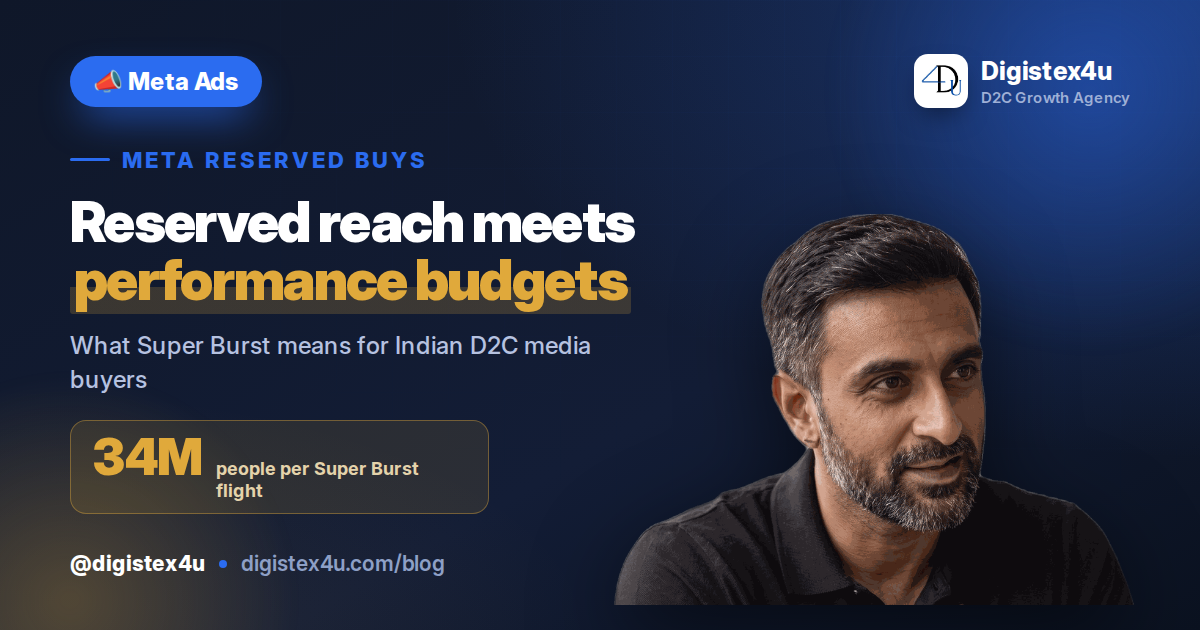
Meta just moved part of your feed off the auction
Every Indian D2C media buyer has built their whole mental model around one thing: the auction. You set a budget, Meta's system decides who sees your ad and what each impression costs, and prices move minute to minute. That model has been the entire game since Advantage+ took over.
In October 2026, Meta announced a set of formats that sit outside it. The headline one, Ads Super Burst, lets a brand reserve a block of reach in advance, at a price it can see before the campaign runs. Reserved media is normal in TV and in big-publisher display, but it's new territory inside the Meta feed, and it's worth understanding before a sales rep or an auto-recommendation talks you into one.
Here's what landed, and the honest answer to whether a performance-led D2C brand should care.
The four things Meta actually shipped
Meta grouped these under "brand advertising," which is the first clue about who they're for. Four pieces were announced on October 15, 2026, and they're at very different stages.
Ads Super Burst
This is the reserved buy. You book a concentrated window of roughly 3 to 24 hours to reach a large audience, with optional category exclusivity so a direct competitor can't run the same slot against you in that window. You estimate cost and reach in Reach Planner before committing.
Meta says early advertisers saw a median 2.9-point lift in ad recall and reached about 34M people per campaign flight. Read those as study figures, not a promise. Meta describes Super Burst as moving toward general availability in October 2026 on a phased rollout, so whether it's switched on for your account is something to check, not assume.
First Impression Ads
A premium Facebook Feed placement that gives one advertiser per day the first ad a user sees when they open their feed. It's a limited US test with no India date, so for now it's a "watch this space" item rather than anything to plan around.
Reels Trending Ads
This one is live now, and it's the most useful of the four for a performance brand. Your ad runs right after popular Reels on Facebook and Instagram, and you choose from 15 always-on content topics, with new Home & Garden and Spanish-language categories plus seasonal holiday and sports themes. Custom audience exclusions are expected later in the year. Meta reports more than a 5-point lift in action intent against control groups.
Aggregated View Time
Not an ad format, a measurement tool. It adds up how long someone spends with your content across a week instead of scoring each view on its own. It's in early alpha, and Meta's supporting stat, a reported 32% higher offline sales, is its own internal number. Interesting, not yet actionable.
Reserved reach vs the auction you already know
The real shift here is the buying model, not the creative. If you've only ever run auction campaigns, this table is the part to internalise.
| What you're comparing | Auction (Advantage+, normal campaigns) | Reserved buy (Super Burst) |
|---|---|---|
| How you pay | Variable CPM, set by live demand | Fixed price booked ahead in Reach Planner |
| What you're buying | Outcomes (purchases, leads) at a target cost | A guaranteed window of reach |
| Who it's for | Acquisition and retargeting | Launches, awareness, seasonal spikes |
| How you judge it | ROAS, CPA, cost per lead | Ad recall, reach, frequency |
| Competitor can crowd you out? | Yes, if they outbid you | No, with category exclusivity for the window |
| Predictability | Low (prices swing) | High (you know the cost before it runs) |
The trap for a D2C brand is comparing them on the same yardstick. A Super Burst that cost a lot and drove few next-day purchases didn't fail; you judged a reach product on a sales metric. If you can't attach a brand goal to a buy like this, you shouldn't be running it.
Does an Indian D2C brand actually need this?
Most don't, most of the time. The daily job of an Indian D2C account is still auction-based acquisition and retargeting at a ROAS that keeps contribution margin positive. Reserved reach doesn't change that work, and spending a brand-reach budget you don't have is the fastest way to blow up your blended numbers.
But there are two moments where a reserved burst earns its place.
When a Super Burst can be worth it
A genuine product launch is the clearest case. If you're putting a new hero SKU into the market and you want a dense wall of awareness across a single day, so that your retargeting and search demand have something to catch, a reserved window gives you reach you can count on instead of an auction that may throttle your delivery exactly when you need volume.
Picture the mechanic concretely. You book a Super Burst on launch morning and land one or two exposures across a large slice of your target audience in a few hours. That audience is now warm. The job for the rest of the week is to catch it: Advantage+ retargeting on the people the burst reached, branded search ready for the ones who go looking, and your landing page tuned for the traffic. The burst doesn't close the sale; it manufactures the demand your performance campaigns then convert. Judge it on how much cheaper and faster your retargeting works in the days after, not on same-day purchases.
The second is a festive or event spike, a Diwali drop, a big sale day, a cricket moment, where everyone's bidding at once and auction CPMs spike anyway. A price you locked in beforehand can look sane next to what the auction does on the day. If you're already planning paid media around these peaks and want a partner to model whether reserved reach beats auction on your numbers, that's exactly the kind of call our performance marketing team runs before the budget goes out.
When it's just expensive
If your goal is purchases this week, a stable ROAS, or squeezing more from warm audiences, reserved reach is the wrong tool. So is buying a burst because it's new. A small or mid-size D2C brand with a tight CAC target gets more from better creative and cleaner retargeting than from a one-day reach spike it can't tie to revenue.
The format to actually test first
Skip Super Burst and First Impression for now unless you have a real launch and a real brand budget. Reels Trending Ads are the sensible first move: they're live, they work for both brand and performance goals, and the topic selection lets you put your ad next to context that fits your product instead of leaving placement entirely to the system.
Start small. Run your best-performing Reel as a Trending Ad against one or two relevant content topics, keep a normal Reels campaign running beside it as a control, and compare hold rate, action intent and downstream conversions over two weeks. If the trending placement lifts the numbers that matter, scale it. If it doesn't, you've spent a test budget, not a launch budget.
One caution on topic choice: pick context that genuinely fits the product, not the topic with the most reach. A snack brand next to food content and a home brand in Home & Garden both borrow relevance from what plays before them, and that's the whole point of the format. A mismatch, your skincare ad after sports clips because the sports topic looked bigger, buys you impressions without the context lift. The creative also has to earn the first second the way any Reel does; the placement gets you a better neighbourhood, not a pass on a weak hook.
How to decide this quarter
Run the decision in this order, and it stays simple:
First, is there a real brand moment in the next 90 days, a launch, a festive peak, a category push? If no, none of the reserved formats are for you yet; keep optimising the auction. If yes, set a brand-reach budget that's separate from your acquisition pool, so a reach buy can't eat your performance spend.
Then check Reach Planner for whether Super Burst is live on your account and what a window would cost against your audience. Treat Meta's recall and reach figures as directional, model your own expected frequency, and decide whether that reach is worth the fixed price versus letting the auction run hot on the day.
And whatever you test, measure it on the right metric. Auction campaigns answer to ROAS and CPA. Reserved buys answer to recall, reach and frequency. Hold those two columns apart in your reporting and these new formats stop being confusing and start being just another line you can choose, or ignore, on purpose.
Sources: Meta Brand Building Summit announcement.
Frequently asked questions
Is Meta Super Burst available in India yet?
How is Super Burst priced compared to normal Meta ads?
Can Super Burst drive sales for a D2C brand?
What is the difference between Reels Trending Ads and normal Reels ads?
Ready to put this into action?
Digistex4u runs performance, CRM, CRO and growth as one engine for D2C brands. Book a free 20-minute call and we'll map your fastest path to scale.
Get the D2C growth playbook
One practical teardown a week — the Meta, Google, SEO, CRM and retention tactics we run on real D2C brands. No fluff, no spam.