Two companies you rarely think about just changed your odds in AI search
Most Indian D2C founders have never opened a NIQ report in their life. It's a retail-measurement giant — the kind of firm that sells shelf and sales data to huge FMCG brands. So a press release about NIQ and Google Cloud is easy to scroll past.
Scroll back. On October 29, 2026, the two announced a partnership to advance agentic commerce, and the plain-English version is this: Google wants the AI that shoppers ask for recommendations to be less likely to make things up, and it's bringing in outside data to do it. When the machine that decides "which protein powder should I suggest?" gets better data, every brand hoping to be that suggestion is affected — including yours.
What Google and NIQ actually agreed
Here's the confirmed shape of it, straight from the joint release, with the hype stripped out.
What NIQ puts on the table
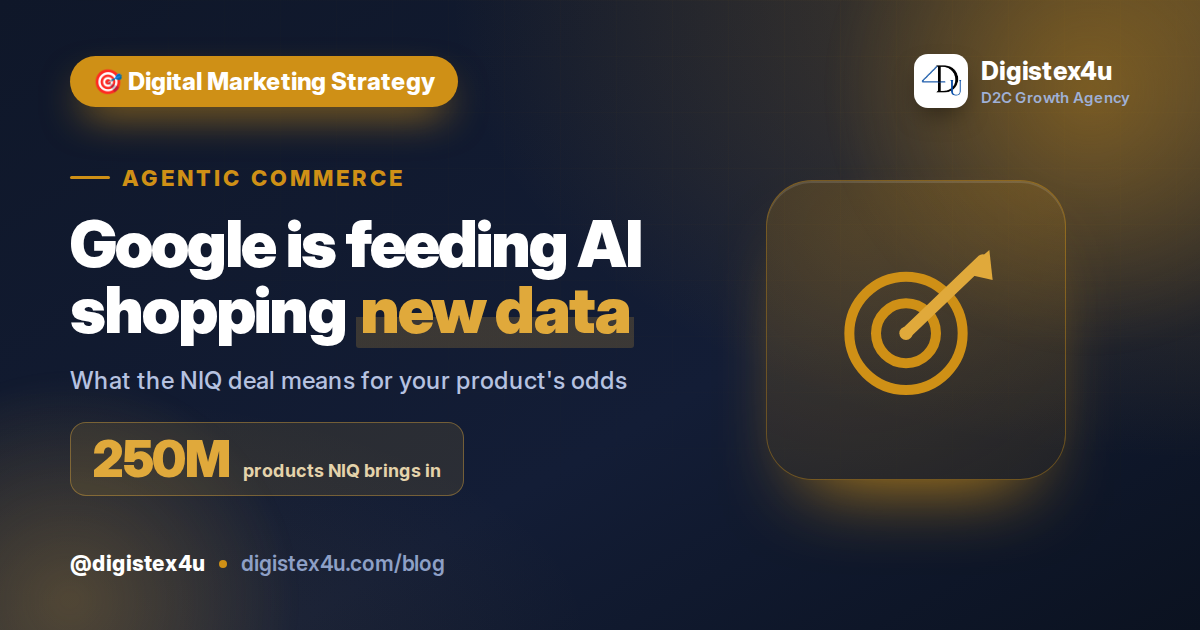
NIQ is bringing what it calls Commerce Intelligence: product data on 250M+ products, plus store-level tracking of retail locations and sales across 90 countries. In other words, not just "this product exists" but "here's what it is, and here's where it's actually selling and available." That second half — real-world availability — is the part worth underlining.
What Google puts on the table
Google brings its Shopping Graph, which it describes as more than 60 billion product listings, and its AI commerce stack. The stated goal, in the release's words, is "to identify relevant products and assess local availability, helping consumers find what they're looking for and supporting agentic shopping experiences." NIQ is also folding Google's open-source marketing-mix-modelling framework, Meridian, into its own measurement platform.
One honest caveat: the release says the companies have "agreed to partner," not that anything is "signed," and promises that specific milestones will come later. So this is a direction of travel, not a shipped feature you can log into tomorrow. Don't let anyone sell you an "agentic optimisation package" off the back of it.
The quiet part: availability beats discovery
The agentic-commerce conversation so far has been obsessed with discovery — getting your brand mentioned when someone asks an AI for options. This deal points at something less glamorous and more useful: availability.
Think about how a good human shop assistant works. They don't just know the catalogue; they know what's in stock and what you can actually walk out with. An AI agent that recommends a product that's sold out, or not deliverable to your pincode, is useless — and it erodes trust in the whole experience. That's exactly the gap NIQ's availability data is meant to close.
For a D2C brand, that reframes the job. It's not only "does the AI know I exist?" It's "does the AI know my product is in stock, priced correctly, and buyable where this shopper is?" Stale feeds, out-of-stock items left live, and wrong prices don't just cost you a classic Shopping impression anymore. They quietly take you out of the running when an agent is picking what to recommend.
What this looks like in an Indian cart
Make it concrete. A shopper in Jaipur asks an assistant for "a good magnesium supplement delivered by tomorrow." The agent doesn't necessarily want the most famous brand — it wants one that's actually in stock, deliverable to a Rajasthan pincode on time, and priced where the shopper expects. If your listing says "in stock" but your 3PL can't reach that pincode by tomorrow, or your price updated on your website but not in your feed, you're the wrong answer even when you're the better product. Availability data is how an agent avoids recommending something a shopper can't get — and it's how your accuracy gets rewarded and your sloppiness gets punished, long before anyone sees your ad.
What this deal changes vs what it doesn't
A clear-eyed split, so you don't over- or under-react:
| Question | What changes | What doesn't |
|---|---|---|
| Should I care? | Yes — the data behind AI shopping is getting better and more availability-aware | It's not a crisis; this is a months-and-years shift, not a week |
| Is there a new tool to use? | No new D2C-facing product was announced | Your feed, structured data and merchant setup are still the controls |
| Does my product data matter more? | Yes — accuracy and availability signals carry more weight | The fundamentals are the same ones good brands already do |
| Do I need an "agentic strategy"? | No | Doing classic discovery well already covers most of it |
| Will my brand get recommended? | Not promised — the deal is about data quality, not favouring any brand | You still earn it with real reviews, ratings and fit |
The honest take: don't over-rotate on one press release
It's tempting to read a Google partnership and sprint to overhaul everything. Resist that. Nothing in this announcement gives a specific brand a shortcut, and no one outside Google and NIQ knows yet how the data will actually flow into shopping answers. The release is careful to say the goal is making agentic commerce "more accurate, useful and measurable" — not handing anyone a ranking lever.
The brands that quietly benefit from shifts like this are the ones that already keep their house in order: correct feeds, honest stock, structured data, reviews that reflect real buyers. If that's you, you don't need to do anything dramatic this week. If it's not, this is a decent nudge to fix the boring stuff before the next festive cycle.
What Indian D2C brands should actually do
Two moves, both unglamorous, both worth it.
Get your product data boringly correct
Audit your Google Merchant Center feed for the usual sins: missing GTINs, thin titles, wrong or stale prices, out-of-stock products still showing as available. Add or clean up product structured data on your store so the same facts are readable on your own pages. This is the single highest-leverage thing you can do, and it pays off in classic Shopping and AI-driven discovery at once.
Start treating stock as a marketing signal
If your operations and marketing teams don't talk, this is the moment to connect them. An item that's perpetually "out of stock but still listed" is now a liability in more places. Build a habit of pulling dead SKUs, flagging low stock, and keeping availability accurate in your feed. A simple weekly check — which SKUs are low, which are dead, which prices drifted — keeps your feed honest without much effort, and it compounds across every channel that reads it. If you want a partner who treats feed hygiene, availability and measurement as one connected system rather than three separate chores, that's the kind of work a growth marketing team should own end to end.
How this fits with the rest of the agentic scramble
Google isn't the only one doing this. Shopping is being wired into AI assistants across the board, each racing to make its recommendations trustworthy enough that people actually buy on them. The common thread is data — product details, prices, reviews, and now availability. The Google–NIQ deal is one of the better-funded moves in that race, with a useful bias toward what's genuinely buyable rather than just what's catalogued somewhere.
For a D2C brand, the good news is you don't have to bet on a winner. The same clean feed, honest stock and structured data that help you in Google's ecosystem help you in every other assistant that leans on similar signals. You do the work once and benefit in several places at the same time. That's the opposite of the usual platform trap, where every channel demands its own separate playbook.
Where this is heading
Strip away the corporate language and the trend is simple: AI shopping agents are only as good as the data they're fed, and the big platforms are now spending real money to improve that data. The Google–NIQ deal is one piece of that, with a useful tilt toward real-world availability.
You don't need to chase it. You need to make sure that when these systems look up your products, they find accurate, in-stock, well-described listings and reviews that match reality. Get that right and you're ready for whatever shape agentic commerce takes next — without betting your quarter on a single press release.
Frequently asked questions
What did Google and NIQ actually announce?
Does this change anything for a small Indian D2C brand right now?
Is this a signed deal or just a plan?
Should I be optimising for AI agents instead of Google Search?
Ready to put this into action?
Digistex4u runs performance, CRM, CRO and growth as one engine for D2C brands. Book a free 20-minute call and we'll map your fastest path to scale.
Get the D2C growth playbook
One practical teardown a week — the Meta, Google, SEO, CRM and retention tactics we run on real D2C brands. No fluff, no spam.