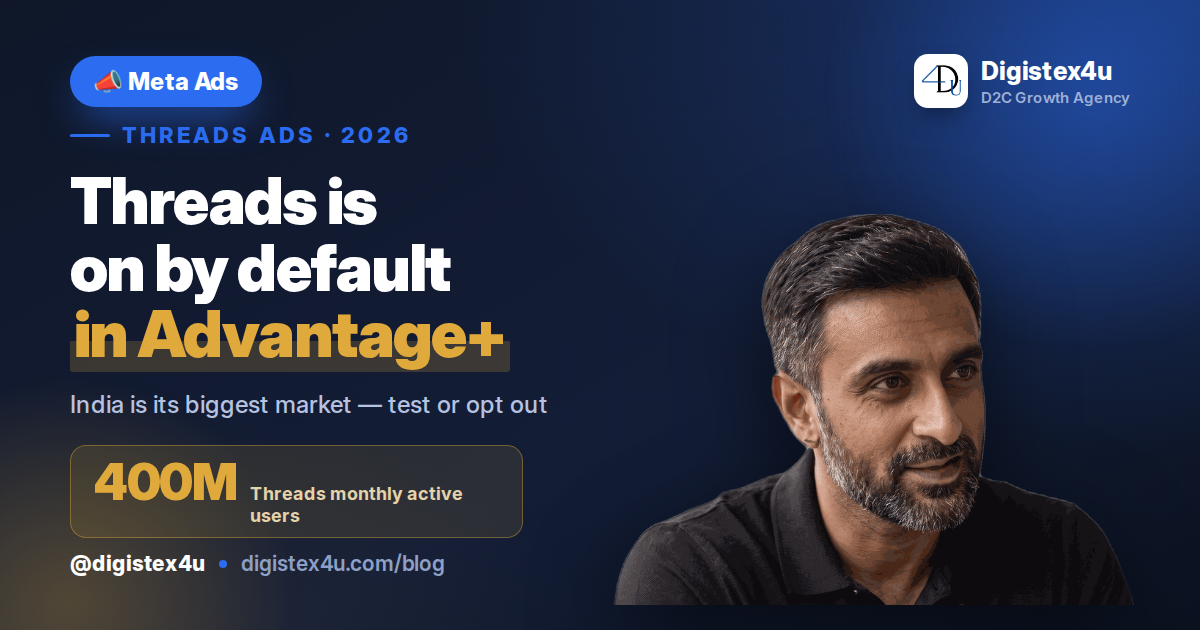
For a year, Threads ads were a curiosity you could ignore — a test running in a handful of markets, easy to file under "later." That grace period is over. In late January 2026, Meta started rolling Threads ads out to every market and every advertiser, a move CNBC, Campaign and eMarketer all reported as the platform's global ad launch. If you run Meta ads for a D2C brand in India, Threads stopped being optional the day that switch flipped.
Here's the part that catches brands off guard: you probably didn't choose it, and it's probably already spending your money. Threads is a default placement inside Advantage+, so unless you went in and excluded it, your campaigns have been serving there. That's not a reason to panic — Threads may be quietly earning its keep. It's a reason to look, because India is Meta's biggest Threads ad market, and a placement this large deserves a deliberate decision rather than a shrug.
What actually changed in early 2026
From a quiet test to a global switch
Threads ads didn't appear overnight. Meta opened a limited test with a small group of advertisers in January 2025 (starting in the US and Japan), widened it to 30-plus countries by around April 2025, and added carousel and catalog formats in October 2025. The late-January 2026 rollout was the finish line: ads on Threads for all eligible advertisers worldwide, running through the same AI-powered delivery system that already personalises Facebook and Instagram, per Meta's announcement as covered by Campaign and PPC.land.
Practically, that means you don't need a Threads profile or a separate content strategy to run there. You can build Threads ads from existing Instagram or Facebook posts inside Ads Manager. The plumbing is the Meta system you already use — Threads is a new surface on top of it, not a new tool to learn.
Why "default-on" is the part that matters
The detail that trips up most Indian D2C advertisers is placement behaviour. New Advantage+ campaigns include Threads automatically, and initial delivery there stays modest while the placement ramps. JumpFly and PPC.land both flagged the same thing: if you want out, you opt out — the system won't ask.
So the real question in 2026 isn't "should I turn Threads on." It's "Threads is on; is it pulling its weight for my brand, and how would I know?" That reframes the whole conversation from a launch decision to an audit.
Why India is the market to watch
Threads reached roughly 400 million monthly active users around the global ad launch, and India is its single largest ad-reach market, with the core audience skewing toward men aged 16–24 (Campaign US, citing October 2025 figures). For a D2C founder, that demographic tilt is the whole story — it decides whether Threads is a gift or a leak.
If you sell men's grooming, gadgets and accessories, sneakers, gaming gear or fitness supplements, that young-male skew lines up with your buyer, and Threads could be cheap incremental reach. If your customer is a woman over 30 buying skincare, sarees or jewellery, the same audience could mean spend going to people who won't convert — and for COD-heavy catalogues, an unqualified younger audience can quietly raise your return-to-origin risk too. Same placement, opposite verdict, depending entirely on who you sell to.
Should you keep Threads on? A decision table
Rather than a blanket yes or no, match the placement to your brand's reality:
| Your situation | Sensible 2026 move |
|---|---|
| Buyer is 18–30, male-leaning (grooming, gadgets, sneakers) | Keep Threads on; test a dedicated 4:5 creative variant |
| Shopify catalogue already synced to Meta | Let Advantage+ catalog ads run on Threads — a free test with existing assets |
| Buyer is women 30+ (skincare, jewellery, sarees) | Check Placements data; consider excluding if ROAS lags |
| Heavy COD with return-risk on younger audiences | Watch RTO by placement before scaling Threads spend |
| You've never opened your Placements breakdown | Do that first — you may already be spending on Threads |
The table isn't advice to switch Threads off. It's a prompt to decide on purpose, using your own account's numbers rather than a headline.
How to build Threads-native creative
Formats that run
Threads supports single image, video, image-only carousels, Advantage+ catalog ads and app ads (PPC.land, Campaign US). For Shopify brands syncing a product catalogue to Meta, the catalog ads are the easy win — they're eligible on Threads with zero new creative, so you can test the placement before you invest in bespoke assets. Third-party brand-safety verification is available through Integral Ad Science, DoubleVerify and Scope3 if adjacency matters to you, per MediaPost.
Copy rules that trip brands up
Threads has quirks that punish lazy repurposing. Meta recommends a 4:5 aspect ratio, keeps primary text roughly 80–160 characters, caps headlines around 40 characters, and — the big one — doesn't support hashtags or clickable links inside the primary text (PPC.land). If your Instagram captions are stuffed with #tags and a "link in bio," they'll read badly here.
The fix is to write for the feed's conversational tone: a short, punchy hook, no hashtag clutter, and a clear call to action that leans on the ad's own button rather than a pasted URL. For Indian D2C, a click-to-WhatsApp CTA often works better than sending people hunting for a link that Threads won't render.
Three mistakes brands make on Threads
The early Indian accounts running Threads tend to trip on the same three things. First, they judge the placement on repurposed Instagram assets — square creatives and link-stuffed captions that Threads renders poorly — then blame the placement for weak numbers that were really a creative problem. Second, they scale Threads spend before checking return-to-origin on COD orders, so a flood of cheap clicks from a younger audience turns into a pile of refused parcels. Third, they treat "it's default-on" as permission to ignore it, which is how a placement ends up eating budget for months without anyone reading the line.
None of these are Threads' fault, and none are hard to avoid. Build one native creative, watch RTO by placement, and read the numbers monthly. The brands that lose money on Threads in 2026 are almost always the ones who never looked at it, not the ones who tested it properly.
A 20-minute Threads audit for your account
You don't need a new strategy to get this right — you need to see what's already happening:
- Open the Placements breakdown in Ads Manager and filter to Threads. Note spend, ROAS and cost per result against your other placements over the last 30 days.
- Read it against your buyer. If your audience skews female and older, be sceptical of Threads spend; if it skews young and male, look for underpriced wins.
- Check COD return rate by placement if you sell cash-on-delivery — cheap clicks that don't stick aren't cheap.
- Test one native creative. Build a 4:5 variant with clean, link-free copy and let it run before you judge the placement on assets designed for a different feed.
- Decide and document. Keep it on, cap it, or exclude it — but make it a choice you can explain.
If you'd rather have a team own this ongoing optimisation across placements, that's exactly the kind of account management our performance marketing service handles for D2C brands — reading placement-level data and moving budget to what actually converts, not what a platform switched on by default.
The takeaway
Threads went from a test you could ignore to a default placement quietly spending your budget, and India sits at the centre of it as Meta's largest Threads ad market. That combination — big, default-on, and demographically specific — is why a shrug is the wrong response in either direction. Don't reflexively kill it, and don't let it run blind. Open the Placements breakdown, weigh it against who actually buys from you, test one properly-built creative, and make Threads a decision instead of an accident. The brands that treat it as a deliberate line item in 2026 will find the cheap reach; the ones who never look will keep paying for the audience that was never theirs.
Sources: CNBC ("Meta to begin rolling out Threads ads globally," January 2026); Campaign US and Campaign Asia ("Meta rolls out ads on Threads globally," 2026); eMarketer ("Threads expands ads to global market," 2026); PPC.land ("Meta finally brings Threads ads to every user," 2026); JumpFly Digital Marketing ("Threads Ads Go Global," 2026); MediaPost (2026). Threads audience figures per Campaign US citing October 2025 data.
Frequently asked questions
When did Threads ads become available in India?
Are my Meta ads already running on Threads without me choosing it?
What ad formats does Threads support?
Is Threads worth it for a D2C brand?
Ready to put this into action?
Digistex4u runs performance, CRM, CRO and growth as one engine for D2C brands. Book a free 20-minute call and we'll map your fastest path to scale.
Get the D2C growth playbook
One practical teardown a week — the Meta, Google, SEO, CRM and retention tactics we run on real D2C brands. No fluff, no spam.