The number that should reset your festive playbook
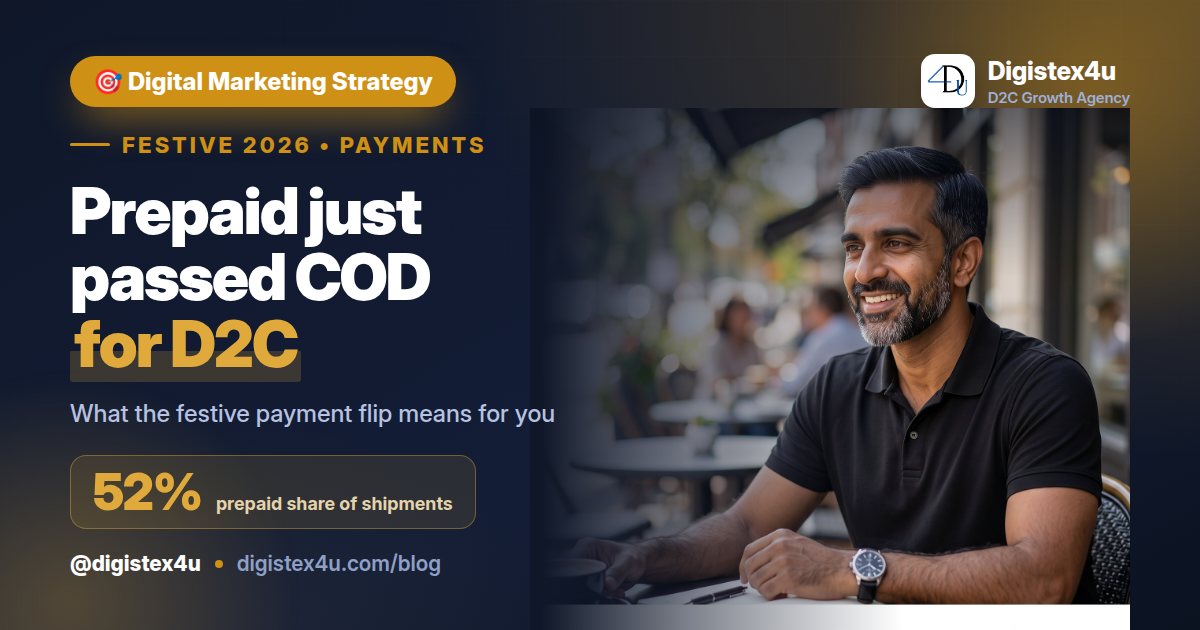
Here's the finding, straight: across a fixed cohort of 200 Indian D2C brands tracked by ClickPost, prepaid shipments overtook cash-on-delivery this festive window. Prepaid's share rose from 46% last year to 52% this year — a six-point swing that, in a category India built on COD, is a genuine flip rather than a rounding error.
The cohort is a clean read because it's the same 200 brands measured in both windows (each shipping more than 500 forward orders), comparing the 2025 period to this year's October 9–13 window. So you're seeing a like-for-like move, not a new sample sneaking in. If your brand is still planning around "COD is king," this is the year that assumption quietly stopped being true.
Why the flip matters more than the headline suggests
A payment method sounds like plumbing. It isn't. It decides how much cash you hold, how many parcels come back, and how big the average order is. When the mix moves, the economics of every single order move with it.
Prepaid is growing faster, so the gap widens
This wasn't a one-off wobble. In the same window, prepaid shipments grew about 47% year on year while COD grew about 27%, against total D2C shipment growth of 31.4% (3.12 million parcels up to 4.10 million). Prepaid isn't just ahead — it's pulling away. Build for where the line is heading, not where it sat two seasons ago.
Prepaid baskets are bigger
The median prepaid basket came in around ₹1,044 versus ₹870 for COD. That's roughly a fifth more per order from the payment type that also costs you less to fulfil. So the shift isn't only a cash-flow story; it's an average-order-value story too. Every point of mix you move toward prepaid tends to lift the basket, not just de-risk it.
The hidden tax on a COD-heavy brand
If most of your festive orders are still COD, you're carrying costs that don't show up on a single line of your P&L but add up fast.
| Cost of a COD-heavy mix | What it does to you |
|---|---|
| Return-to-origin (RTO) | Parcels refused at the door come back; you eat two-way freight and handling |
| Locked-up cash | You wait days to weeks for the courier to remit collected cash |
| Lower AOV | COD baskets ran smaller (₹870 vs ₹1,044 median) |
| Fulfilment overhead | Cash handling, reconciliation, and failed-delivery follow-ups |
| Thin buyer data | COD buyers often skip the details that power retention later |
None of these is fatal on its own. Together, through a high-volume festive week, they decide whether your "record sales" actually turn into record profit.
A quick way to feel the RTO cost
Run the rough math on your own orders. Say a COD order ships at ₹870 and your RTO rate on COD is 15%. Every failed delivery costs you forward freight, return freight, and handling — often ₹120–₹180 a parcel in two-way shipping alone, before you count the packaging and the staff time to re-inventory it. On 1,000 COD orders, 150 come back, and you've spent real money moving goods in a circle while that ₹870 was never collected. Prepaid orders simply don't bounce that way, because the buyer already paid. You're not just earning a bigger basket on prepaid — you're skipping a cost that quietly scales with your COD volume.
What to do at checkout (where prepaid is won or lost)
The instinct when you see data like this is to rip out COD. Resist it. COD still converts the first-time buyer in a tier-2 city who's never heard of you and won't risk money upfront on an unknown brand. The move isn't to block COD — it's to make prepaid the easier, more rewarding choice.
Lead with a prepaid incentive, not a COD ban
A small prepaid discount or free shipping on prepaid, shown right at the payment step, does most of the persuading. Pair it with a modest COD handling fee so the contrast is obvious. You're pricing in the real cost of COD rather than pretending it's free.
Fix the trust gap for new buyers
Much of COD demand is a trust tax. A first-time buyer who picks cash on delivery is usually saying "I'll believe this brand when the parcel is in my hand" — not "I prefer cash." Visible reviews, a clear return policy, a real support number, and recognisable payment logos (UPI especially) lower the fear that makes someone reach for COD. The cheaper you make trust, the cheaper prepaid becomes, because the shopper no longer needs the door-step guarantee to feel safe handing over money.
Make UPI the path of least resistance
UPI is the engine behind this shift. A one-tap UPI option, correctly surfaced on mobile, converts far better than making someone hunt for card fields. If your checkout buries UPI, you're manufacturing COD orders.
Watch the order, not just the option
The sequence matters as much as the offer. If COD is the first, pre-selected choice a shopper sees, many will take it out of habit before they ever notice the prepaid reward. Put prepaid methods first, make UPI the default highlight, and let COD sit below as the fallback it should be. You're not hiding it — you're ordering the choices the way the economics want them ordered.
Close the loop after the order ships
A prepaid-first checkout only holds if the post-purchase experience earns trust. Fast dispatch, a clear tracking link, and a no-drama return policy turn a nervous first-time prepaid buyer into a repeat one. Every time a prepaid order goes smoothly, that customer's next order is likelier to be prepaid too — the habit compounds in your favour.
Build prepaid into the campaign, not just the cart
Checkout is the last mile, but you can prime the choice far earlier. This is where strategy and media work together instead of in separate silos, and it's the kind of full-funnel thinking a growth marketing approach is built around.
Seed the offer in the ad
If prepaid carries a discount, say so in the creative and the landing page, not only at checkout. A shopper who arrives already expecting a prepaid reward is far likelier to take it.
Segment your retention by payment behaviour
Your repeat, prepaid-friendly customers are your cheapest growth. Tag them, talk to them differently, and push your acquisition spend toward audiences that resemble them rather than chasing the hardest-to-serve COD segment during peak cost weeks.
Track your own prepaid share weekly
The ClickPost cohort gives you a market benchmark; your job is to know your own number against it. Pull your prepaid-versus-COD split every week through festive, broken down by product and by city tier. A brand sitting at 35% prepaid has a very different opportunity than one already at 55%, and the only way to know which lever to pull is to measure where you actually stand rather than assuming you look like the market.
The decision: nudge, don't ban
Put the two approaches side by side and the call gets easy.
| Approach | Effect |
|---|---|
| Remove COD entirely | Protects margin but can gut conversion from first-time and tier-2/3 buyers |
| Keep COD, nudge prepaid | Preserves reach while steadily moving mix, AOV, and cash flow the right way |
| Do nothing | You keep paying the COD tax while the market moves to prepaid without you |
For most Indian D2C brands, the middle path wins. You keep the door open for buyers who need COD to say yes the first time, and you make prepaid the obvious choice for everyone else.
The takeaway for 2026 and beyond
One festive window doesn't rewrite a market by itself, but this one points the same way as everything else happening in Indian payments — UPI everywhere, digital trust rising, cash receding. Prepaid at 52% this festive season is a signpost, not a blip.
So treat payment mix as a growth lever this season, not plumbing you ignore. Price COD honestly, reward prepaid, and design the checkout around UPI, and you quietly keep more of every rupee the festive rush brings in. Leave the mix to chance and you'll post a big topline in October, then spend January wondering where the profit went.
Frequently asked questions
Should I just remove COD to force prepaid?
What's the simplest prepaid nudge that works?
Does prepaid really reduce returns?
Is this shift only a festive thing?
Ready to put this into action?
Digistex4u runs performance, CRM, CRO and growth as one engine for D2C brands. Book a free 20-minute call and we'll map your fastest path to scale.
Get the D2C growth playbook
One practical teardown a week — the Meta, Google, SEO, CRM and retention tactics we run on real D2C brands. No fluff, no spam.