The number that should change how you think about FAQ content
For years, the People Also Ask box was a reliable little traffic faucet. You'd answer a question cleanly, Google would slot your page into that expanding accordion, and curious searchers would click through. A lot of D2C content calendars were quietly built around it — "how to use," "is it safe for," "what's the difference between."
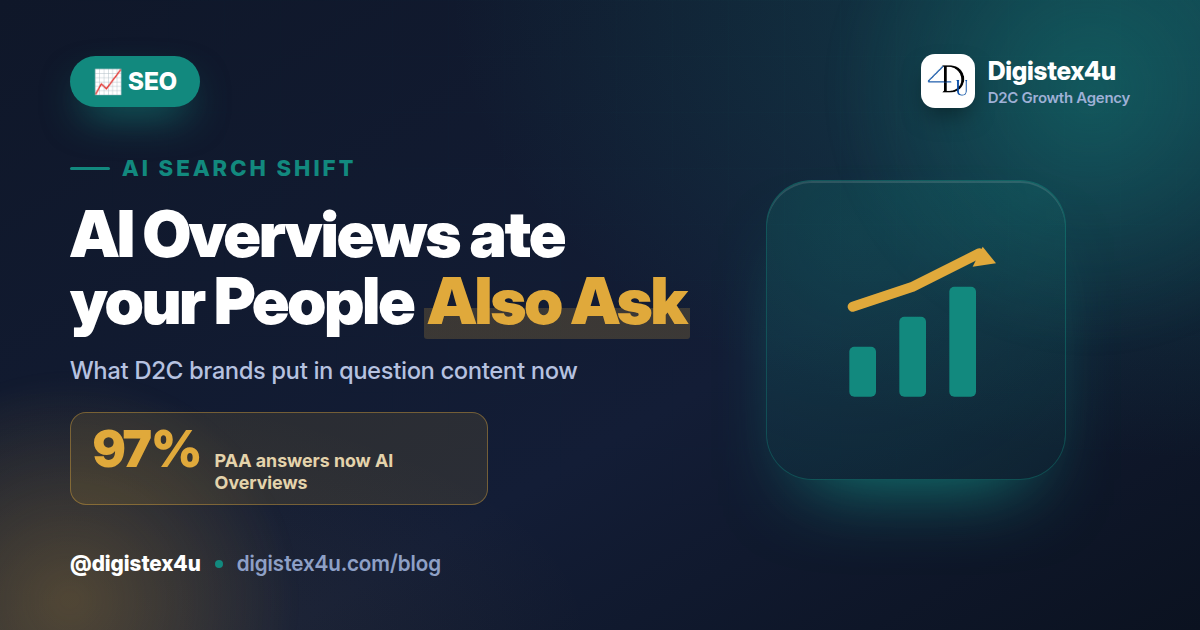
That faucet has mostly been turned off, and the number showing it is stark. According to an analysis by Mark Williams-Cook of AlsoAsked, reported by Search Engine Roundtable in September 2026, 97% of People Also Ask answers in the first week of September were generated by AI Overviews, up from 86% in August and from roughly 12% about fourteen months earlier. In plain terms, the answers inside that box are now written by Google's AI, not lifted verbatim from a single ranking page.
Before anyone rewrites their whole content plan, it's worth being precise about what this does and doesn't mean — because the implications for D2C are real but narrower than the headline suggests.
What the data actually says (and what it doesn't)
First, the source. This is third-party measurement, not a Google announcement. AlsoAsked analysed a sample of about 19.2 million English-language PAA results. A second tool, Allintitle, reported an even higher 100% from August, which Williams-Cook's more conservative 97% figure tempers. So treat the direction as well-established and the exact percentage as a careful estimate rather than gospel.
It's AI Overviews, not AI Mode
Several news recaps have described this as "People Also Ask answered by AI Mode." That appears to be a mislabel. The underlying analysis points to AI Overviews — the summaries that sit on the standard search results page — generating the PAA answers. The difference matters to a D2C brand: AI Mode is a separate conversational surface most Indian shoppers haven't adopted, while AI Overviews appear right where your existing organic traffic already lands.
The sample is English and global
Williams-Cook himself noted it "seems highly likely we are on track for 100% shortly." That's a forward-looking read, not a measured fact, so hold it loosely. And because the sample is English-language and worldwide, the exact behaviour on India-specific or Hindi queries may differ. The trend is almost certainly the same; the precise share on your query set is something only your own Search Console data will tell you.
Why this hits D2C question content specifically
Not all content is equally exposed. The pages most at risk are the ones many D2C blogs are stuffed with.
Definitional answers are the easiest to generate
"What is a serum?" "How many mg of collagen per day?" "Is cold-pressed oil better?" These are short, factual, broadly-known answers. They're exactly what an AI Overview can assemble and present without needing a searcher to click anywhere. If a big chunk of your blog is this kind of quick-answer content written to catch PAA traffic, that traffic is the most likely to have quietly thinned over the past year.
The click is replaced by a citation — sometimes
The recap reporting notes that AI Overview PAA answers often cite several sites, which spreads any onward clicks thin. So you might still be referenced in the answer, but a citation delivers a fraction of the visits a PAA listing once did. You've traded a click for a mention, and a mention only pays off if your brand name in that answer nudges someone toward a branded search later.
Where D2C still wins the click
The questions that resist a tidy AI answer are the ones still worth chasing: anything comparative and commercial ("X vs Y for oily skin"), anything that needs your specific product or data to answer well, and anything where the honest answer is "it depends, here's how to decide." Those pull clicks because the searcher needs more than a sentence, and they're also the pages most likely to be cited as the source.
Clicks vs citations: a new way to score your FAQ pages
The old scorecard — does it rank, does it get PAA clicks — no longer separates winners from losers. Here's a more useful way to sort your existing question content.
| Content type | PAA click value in 2026 | What it's worth now | Action |
|---|---|---|---|
| Short definitional FAQ ("what is…") | Largely gone | Thin citation at best | Consolidate into deeper guides |
| Dosage / usage / safety basics | Falling fast | Trust signal, little traffic | Keep concise, don't expand |
| Comparison / "vs" / decision | Still strong | Clicks plus citation | Invest and refresh |
| Product-specific how-to | Still strong | Clicks plus conversion | Expand with your own data |
| Buying-intent questions | Strong | Clicks plus revenue | Prioritise and interlink |
The pattern is simple to read off the table: the more a question needs your product, your data, or a genuine judgement call to answer, the more it still pays. The more generic it is, the more it's become an AI Overview's job, not a click you'll receive.
How to write question content that still earns something in 2026
The response isn't to abandon question content — it's to stop writing the kind a machine now handles for free and double down on the kind that still moves people.
Answer things only you can answer
Pull from your own returns data, your customer-service logs, your repeat-purchase patterns. "Why do most customers reorder our face wash at week six" is a question no AI Overview can generate, because the answer lives in your data. That's citable, clickable, and useful all at once. This is the shift we build into content plans when we run growth marketing for D2C brands — question content anchored to proprietary insight rather than generic definitions.
Structure for extraction, write for depth
Lead each section with a clean two-line answer so the content is easy to parse and cite, then earn the click with the depth underneath — comparisons, caveats, your product in context. Being quotable and being worth visiting aren't opposites; the citable sentence up top is what gets you mentioned, and the depth below is what converts the person who does come through.
Consolidate thin FAQs into real guides
Ten flimsy "what is" posts that no longer get clicks are better merged into two or three substantial guides. You reclaim crawl budget, strengthen internal linking, and give AI Overviews a richer source to cite — which is where the brand mention, if you get one, is more likely to land on you.
Move the answer to where the click still happens
If a question answer is now being eaten on the results page, put the useful version somewhere Google isn't summarising it away. The same "how to layer our serum with sunscreen" answer that no longer earns a PAA click can live on the product page, in a post-purchase WhatsApp flow, or in a short reel — surfaces where you own the audience and the click. A take-sheet of a hundred thinning FAQ answers, re-homed across your owned channels, is often worth more than the organic clicks they've lost. Think of the blog question as the seed and your own channels as where it actually converts.
A worked example
Say a skincare brand has a post titled "niacinamide vs vitamin C." The old plan was a tidy 400-word answer to catch the PAA click. The 2026 version leads with a two-line verdict a machine can quote, then goes deep: which skin types each suits, what your own customers reorder, a side-by-side the generic answer can't match, and a clear "here's how to choose for your routine" close. That post can still be cited in the AI Overview and still earn the click from someone who needs the full picture — because the full picture is the part the box never shows.
What to measure now that the PAA click is fading
Stop judging this content purely on rankings. A page can rank, be cited in an AI Overview, and send fewer clicks than last year — that's not a failure, it's the new shape of the channel. Lean on Search Console for impressions and the queries where you still earn clicks, watch branded search volume as a proxy for whether AI citations are feeding discovery, and connect assisted conversions so a blog post that no longer "ranks for traffic" still gets credit when it quietly seeds a purchase weeks later.
Rank trackers are a weaker guide than ever here, partly because Google has been making life harder for scrapers and partly because a top ranking no longer guarantees the click it used to. Your own Search Console data, read against revenue, is the honest scoreboard now. The People Also Ask box isn't coming back the way it was. But the demand behind those questions hasn't gone anywhere, and a store that answers the genuinely hard ones with something only it can say still gets found — in the citation if not always the click.
Frequently asked questions
Is People Also Ask being answered by AI Overviews or AI Mode?
How reliable is the 97% figure?
Should D2C brands stop writing FAQ content?
Does FAQ schema still help?
Ready to put this into action?
Digistex4u runs performance, CRM, CRO and growth as one engine for D2C brands. Book a free 20-minute call and we'll map your fastest path to scale.
Get the D2C growth playbook
One practical teardown a week — the Meta, Google, SEO, CRM and retention tactics we run on real D2C brands. No fluff, no spam.