There's a failure mode in Google Ads that doesn't look like a failure. Your ads all say Approved. There's no policy strike, no disapproval email, nothing red in the account. And yet your impressions have quietly halved, and you can't work out why. In 2026 Google made this scenario a lot more common, and if you're an Indian D2C brand about to spin up a fresh account for the festive season, you're squarely in the group most exposed to it.
The cause is Google's Limited Ad Serving policy, which the company is expanding from a handful of narrow scenarios to every ad surface it runs. Instead of judging each ad, Google is now judging the whole account — how mature it is, whether you've verified who you are, how users have reacted to you — and quietly limiting how often unqualified accounts get shown. Your ads stay Approved the entire time. This post explains exactly what changed, why new D2C accounts fit the risk profile, and the concrete steps to get your account treated as trusted before you spend a rupee on Diwali traffic.
What the policy actually does
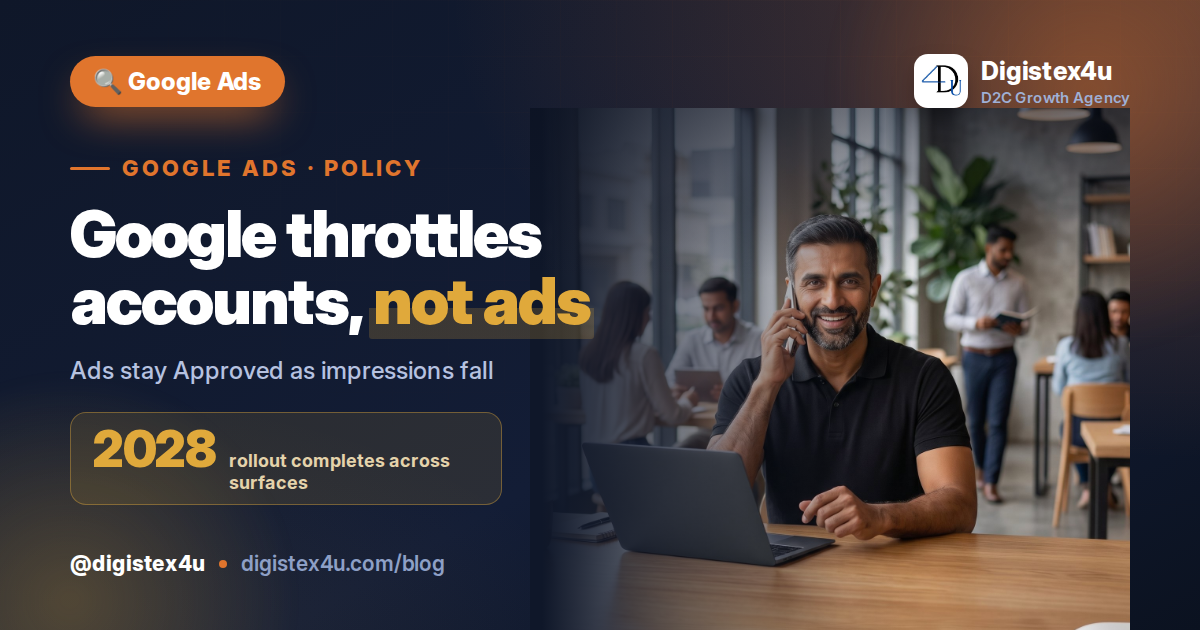
Google's own policy page is blunt about the mechanic. Limited Ad Serving applies across Search, YouTube, Gmail, Play Store and Discover, and the rollout "will begin gradually and will be completed by 2028." So this isn't a one-day switch — it's a phased tightening you'll feel over time.
The line that matters most is this one: "Individual ads will not be disapproved." Google isn't rejecting your creative. It's limiting how broadly an account it doesn't yet trust can serve. Accounts with meaningful impression volume get notifications about the limited serving, but there's no ad-level red flag — which is precisely why brands miss it and burn weeks blaming bids or budget instead.
How Google decides you're "qualified"
Rather than looking at one ad, Google weighs a set of account-level signals. Its policy page names account attributes, user activity and reports, account maturity, ad-format usage, history of policy compliance, advertiser industry, and advertiser verification status. Read that list again with a new D2C account in mind: no maturity, often no verification, no compliance history, and a catalogue Google has never seen. You don't have to break a rule to look risky — you can simply have no trust signals yet.
On the user-reports piece, Google's language (as reported by Search Engine Journal in its June 2026 coverage) is that when users have "persistently and disproportionately" reported that an advertiser's content, products or behaviour don't meet expectations, Google may consider that advertiser unqualified and limit its impressions. For D2C, that ties account health directly to real post-click experience — deliveries, returns, and whether the product matches the ad.
Why Indian D2C accounts are exposed
This lands at the worst possible time in the Indian calendar. The festive quarter is when brands launch new stores, spin up fresh ad accounts, and pour budget in fast — and a fresh account is the exact profile Limited Ad Serving is cautious about.
| Signal Google weighs | Trusted account | Fresh festive account |
|---|---|---|
| Account maturity | Months of clean history | Days old |
| Advertiser verification | Completed | Often skipped |
| Branding on ads + pages | Clear and consistent | Generic / unbranded |
| Ad-to-landing-page match | Tight | Frequently loose |
| Policy-compliance record | Established | None yet |
None of the right-hand column is against the rules. But together they read as "we don't know this advertiser yet", and that's enough to limit serving. The brands most at risk are the ones running white-label or dropship catalogues, generic creative, and stores where the brand barely appears — because there's nothing for Google to build trust on.
The fixes, in order
The good news: every trust signal Google names is something you can build on purpose. Do these before you scale spend, not after your impressions have already cratered.
Complete advertiser verification first
This is the single clearest signal you control. Advertiser verification tells Google who's actually behind the account. On a new account it's the fastest way to move from "unknown" toward "known", so complete it before the account starts spending seriously — not as an afterthought once serving is already limited.
Make your brand obvious everywhere
Google's guidance is to show your brand prominently and consistently across ads and landing pages. That means the store the click lands on should visibly be your brand, the ad should name it, and where the format allows, you pin your own domain to the front of your ad titles. A shopper — and Google — should never be unsure whose store this is. Unbranded, could-be-anyone stores are exactly what the policy is wary of.
Kill generic copy and ad-to-page mismatch
Use specific, honest ad copy instead of interchangeable claims that could belong to any seller. And make sure the ad's promise matches the page it lands on — if the ad sells a festive bundle, the landing page should open on that bundle, not a generic homepage. Mismatch is both a conversion killer and a trust signal working against you.
Earn clean engagement while you're assessed
While Google is deciding whether your account qualifies, give it good signals to read. Build campaigns that earn genuine positive engagement, keep your compliance record spotless, and don't do anything that invites user complaints — slow delivery, misleading claims, products that don't match the listing. This account-trust groundwork is the unglamorous layer our performance marketing team sets up first for D2C brands, precisely because a throttled account makes even great creative invisible.
What to watch for
Set yourself an early-warning check. Once a week, look at whether impressions and reach moved in a way your budget, bids and seasonality don't explain — while every ad still shows Approved. That combination is the fingerprint of limited serving. Check your account-level notifications, not just ad statuses, because that's where Google surfaces it. If you suspect it, the response isn't to raise bids into the void; it's to fix the trust signals — verification, branding, copy, compliance — and let the account re-earn its serving.
The takeaway
Google stopped only policing ads and started judging accounts. Limited Ad Serving spreads across Search, YouTube, Gmail, Discover and the Play Store through 2028, and it works quietly — your ads stay Approved while an untrusted account's impressions get capped. New D2C accounts are the classic at-risk profile: no history, no verification, generic creative, loose ad-to-page matching. The fix isn't a trick, it's trust hygiene done deliberately and early — complete advertiser verification, brand yourself clearly across ads and pages, write specific copy that matches the landing page, and keep your compliance record clean. Do it before the festive spend starts, and you enter the busiest quarter as a qualified advertiser instead of quietly wondering where your impressions went.
Sources: Google Ads Policy Help — "Limited ad serving" / "Update to Limited Ad Serving Policy (August 2026)" (applies to Search, YouTube, Gmail, Play Store, Discover; "Implementation will begin gradually and will be completed by 2028"; qualification signals — account attributes, user activity and reports, account maturity, ad-format usage, policy-compliance history, advertiser industry, advertiser verification status; "Individual ads will not be disapproved"; recommended steps — complete advertiser verification, clear branding, specific copy, pin domain to front of titles, build positive engagement). Search Engine Journal — "Google's Limited Ad Serving update raises questions about advertiser qualification" (23 June 2026; Google's "persistently and disproportionately" reported-by-users language). Search Engine Land — "Google expands Limited Ad Serving policy across all Ads" (August 2026 expansion; notifications, appeals). Common Thread Collective — "Google Ads August 2026: The Limited Ad Serving Expansion" (silent impression drop; higher-risk account profiles).
Frequently asked questions
What is Google's Limited Ad Serving policy?
Will I know if my account is being limited?
Why are new D2C accounts especially exposed?
How do I get my account treated as qualified?
Ready to put this into action?
Digistex4u runs performance, CRM, CRO and growth as one engine for D2C brands. Book a free 20-minute call and we'll map your fastest path to scale.
Get the D2C growth playbook
One practical teardown a week — the Meta, Google, SEO, CRM and retention tactics we run on real D2C brands. No fluff, no spam.