Investigating an apparent referral drop
Picture the Monday-morning version of this. You open analytics, and the ChatGPT referral line you'd been quietly proud of, the one proving your answer-engine work was paying off, has fallen off a cliff. Meanwhile your Direct traffic, the channel nobody fully trusts, has jumped by almost the same amount. Nothing in your content changed. No big launch, no site migration. The numbers just moved.
Before you call an emergency meeting or kill the AEO budget, read this. In early October 2026, a lot of brands saw exactly that pattern, and the cause wasn't lost demand. It was a tracking change in GPT-6 that stripped the information analytics tools use to credit ChatGPT for a visit. Some visits may still have been arriving under a different source label. Check your own data before assuming there was no real traffic loss.
What actually broke, and when
Here's the sequence, as reported by the analysts who caught it. After GPT-6 rolled out, ChatGPT's outbound links lost their UTM tag and their referrer. That's the signal your analytics platform reads to say "this person came from ChatGPT." With it gone, those visits had no identifiable source, so they got dropped into Direct, the bucket reserved for traffic with no traceable origin.
Adobe's Cedric Huesler flagged the effect on roughly 500 pages where ChatGPT had been driving at least 5% of visits. In sampled data from October 9 to 13, ChatGPT visits on those pages fell by about 31,000 a day while Direct visits rose by about 26,000 a day. That near-mirror movement is evidence consistent with misattribution in that sample, not proof that every site avoided a real decline. Huesler called it a bug. Reporting says OpenAI confirmed the issue on October 14, 2026 and began rolling out a fix early the next day.
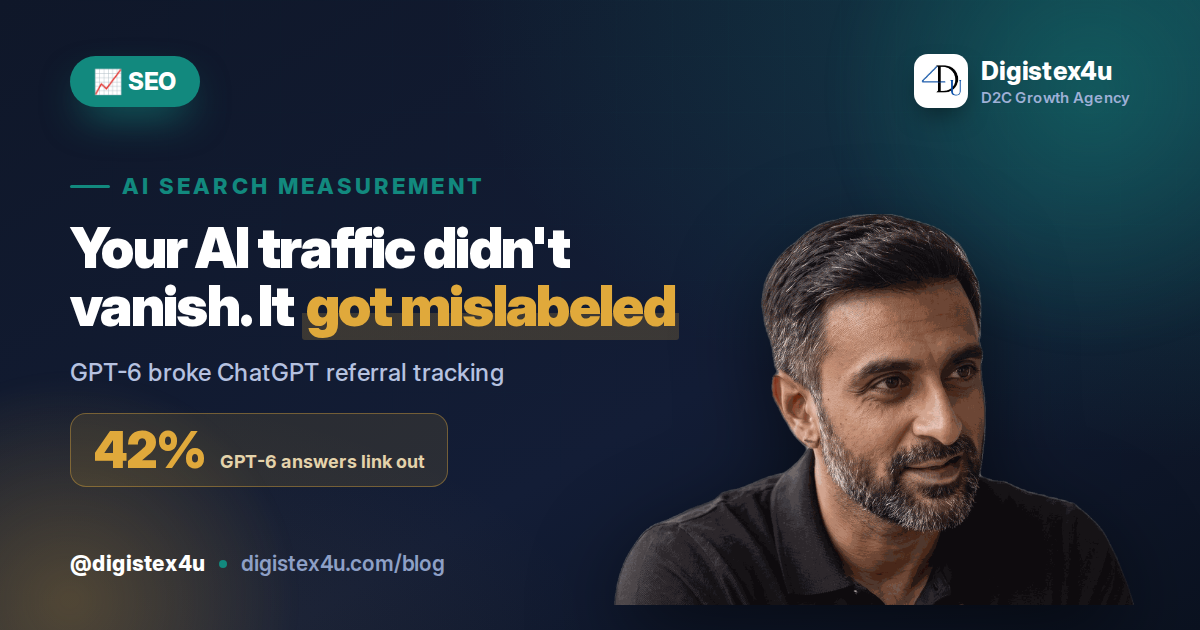
There's a second, longer-lasting shift worth knowing about. Peec AI's Tomek Rudzki, running the same prompts before and after GPT-6, reported that ChatGPT now includes a direct website link in about 42% of answers, up from 8 to 10% before. Of those links, he found roughly 54% pointed to a homepage. Because those links carry no tag either, they also show up as Direct. So even once the referrer bug is patched, more of your AI-driven traffic may keep landing in Direct than it used to, and more of it may be hitting your homepage instead of the product or collection page the question was really about.
Why this matters more for D2C than you'd think
For a content publisher, a referrer bug is an annoyance. For a D2C brand, it can quietly distort decisions that move real money.
If you read early-October numbers at face value, you might conclude your AI search presence collapsed and pull investment from the exact work that's starting to compound. Or you credit a "Direct traffic surge" to brand strength and word of mouth, pat the brand team on the back, and misread where demand is actually coming from. Both mistakes send budget to the wrong place.
It also muddies your conversion picture. Direct traffic and AI-referred traffic usually behave differently, different intent, different landing pages, different purchase rates. When they're blended, your channel-level cost per acquisition and return on ad spend get noisier, and attribution models that already struggle with AI search get one more reason to lie to you.
And the timing could hardly be worse for Indian D2C. This landed in the middle of the festive run-up, when every brand is watching dashboards daily and making fast calls on where to push spend. Read a mislabeled drop in that window and you might cut exactly the channel that's feeding your most considered buyers, the ones who asked an assistant for a recommendation before they bought, right when you can least afford the mistake.
How to tell a misattribution from a real drop
You don't need fancy tooling to diagnose this. You need to look at the right comparison.
| Signal | Looks like misattribution | Looks like a real drop |
|---|---|---|
| ChatGPT referrals vs Direct | ChatGPT falls, Direct rises by a similar amount, same pages | ChatGPT falls, Direct flat or also down |
| Which pages moved | The exact landing pages ChatGPT used to send traffic to | Spread evenly or tied to pages you changed |
| Timing | Lines up with October 8 and the GPT-6 rollout | Lines up with your own edits, a migration, or a core update |
| Total sessions | Roughly flat once you add Direct and ChatGPT together | Down on a combined basis too |
Run the same-page comparison
Pull your top AI-referred landing pages from before October 8 and look at them week over week. If the ChatGPT line dropped and Direct climbed on those same URLs, stop worrying. That's the bug.
Check your combined total
Add ChatGPT referrals and Direct together across the affected pages. If the combined number is roughly stable, you didn't lose traffic, you lost the label on it.
Separate your reporting going forward
Track AI Overview and AI-assistant impressions, referral sessions, and conversions as their own line, so a formatting change on one platform can't quietly rewrite your whole channel story. This kind of measurement discipline is exactly what we build into growth marketing engagements, because a brand that can't trust its own dashboard can't allocate spend with any confidence.
The fix is rolling out, but the lesson isn't going away
OpenAI's patch should restore cleaner referrer data over time. That's good news, and it's worth re-checking your numbers a couple of weeks after the fix lands to confirm your ChatGPT line recovers and your Direct spike settles.
But treat this episode as a preview, not a one-off. AI search traffic now flows through platforms that can change how they format links overnight, with no warning, no release note, and no obligation to preserve your tracking. You saw it here: the tags dropped on October 8 and the public release notes still hadn't logged it days later. Building your measurement on a referrer string that a model update can erase is fragile by design.
What not to do while the data is messy
Panic decisions are the real risk here, so a few don'ts. Don't rewrite your AEO strategy on a single week of October data, the signal is corrupted and you know why. Don't reallocate budget away from AI search content on the strength of that drop alone. Don't declare a "Direct traffic win" to your team or your client and build a story around brand strength that the numbers don't support. And don't retrofit your attribution model to "fix" the Direct spike with a rule, because once OpenAI's patch lands, that rule becomes its own source of wrong numbers.
The one thing worth doing immediately is communication. If you report to a founder or a client who watches dashboards, send a short note now explaining that an October ChatGPT change pushed some referral traffic into Direct, that it's a known issue with a fix rolling out, and that you're tracking combined totals in the meantime. Getting ahead of the question is far easier than un-explaining a panic a week later.
How to measure AI search properly from here
The durable approach leans on signals that don't depend on a platform tagging its own links correctly.
Watch branded search demand. When AI assistants cite you, a share of people don't click the link, they search your brand name instead. A rising branded-query trend in Search Console is one of the cleaner proxies for AI visibility, and no referrer bug can touch it.
Track citations, not just clicks. Tools that monitor whether and how often your brand appears in AI answers tell you about presence even when the click never gets attributed. More prominent links don't guarantee more clicks, so measure the mention and the click as separate things.
Segment your Direct channel. Instead of treating Direct as one lump, break it down by landing page. A sudden pile of Direct traffic to a deep product page nobody bookmarks is almost never truly direct, it's mislabeled referral traffic, and now you know one big reason why.
And mind the homepage shift. If GPT-6 is sending more people to your homepage, make sure that page can actually route an AI-curious visitor toward the product they were asking about. A strong homepage path matters more the moment your deep-link traffic starts arriving one level too high.
The brands that keep their heads here won't be the ones with the fanciest attribution model. They'll be the ones who looked at a scary October chart, asked "did we lose demand, or just lose the label," and checked before they reacted.
Measurement caveat
A rise in Direct traffic cannot identify individual lost referrals. Treat the October observations as a measurement hypothesis to test, not a reason to reassign all Direct visits to ChatGPT. Keep raw reports unchanged and annotate any estimates separately.
Frequently asked questions
How do I know if my ChatGPT drop is real or just misattribution?
Did OpenAI confirm this was a bug?
Why does GPT-6 send more people to my homepage?
Should I still add UTM-friendly tracking for AI platforms?
Ready to put this into action?
Digistex4u runs performance, CRM, CRO and growth as one engine for D2C brands. Book a free 20-minute call and we'll map your fastest path to scale.
Get the D2C growth playbook
One practical teardown a week — the Meta, Google, SEO, CRM and retention tactics we run on real D2C brands. No fluff, no spam.